How to get a liquor license for a restaurant: types, fees and steps
How a US restaurant gets a liquor license: the state agency, beer and wine versus full liquor, population quotas, state fee schedules and the premises diagram.
Short answer
A restaurant liquor license is issued by a state agency, usually with a local step, and the agency decides. Choose the license type first: beer and wine only, or full liquor. Then file the application with a diagram of the premises, notify or post for the community, and wait for the investigation. Fees vary widely: California’s 2026 schedule lists $1,135 for a beer and wine application, while New York’s on-premises liquor fee is $1,792 to $4,352 for two years.

Who issues the license
In the United States the retail license to serve alcohol comes from the state, not the federal government. The federal Alcohol and Tobacco Tax and Trade Bureau (TTB) requires that no one sell distilled spirits, wine or beer without first registering the business on form TTB 5630.5d, for every location, before engaging in business, and it lists bars and restaurants among the retail dealers that must register [1]. That is a registration, not the permission to pour. The permission is the state license, and in many states it also needs a local step: Texas applicants complete city, county and state certificates in the state’s licensing system [2], and New York applicants must give notice to the municipality or community board [3].
Two practical consequences follow. First, the rules differ more from state to state than anything else in opening a restaurant, so the first page you read should be your own state agency’s. The Wobistro state reference lists the food, building and fire codes each state has adopted. Second, a license is not a right. California’s agency says it may refuse a license to a person who has violated the Alcoholic Beverage Control Act or has a disqualifying criminal record, and calls a license a privilege [4].
License types: beer and wine, or full liquor
Most states split restaurant licenses into a narrower license for beer and wine and a broader one that includes distilled spirits. California names them by number. A Type 41 is an on-sale beer and wine license for an eating place, and a Type 47 is an on-sale general license for an eating place that also authorizes distilled spirits; both require a real restaurant with a kitchen and meal sales [5]. New York uses classes: the restaurant beer license is good for 3 years, and the restaurant wine and restaurant liquor licenses for 2 years [6]. Texas sells a mixed beverage permit for spirits and a wine and malt beverage retailer’s permit for beer and wine [7].
The choice is a design decision as well as a legal one. A full-liquor license usually means a real bar with a back bar, ice, glass washing and more storage; a beer and wine license can be served from a service counter and a cooler. If you are unsure which you need, price both before you sign the lease.
Quota states: when the number of licenses is limited
In some places you cannot simply apply, because the number of licenses is capped by population:
- California. The agency says the number of certain retail licenses has been limited since 1939, and that the ratio is one on-sale general license for each 2,000 persons in the county [4]. General licenses such as Type 47 can be applied for through a priority drawing; winning does not guarantee the license will issue, and the only other way is to purchase an existing license of the same type within the same county [8].
- Florida. The statute says licenses under section 565.02(1)(a)–(f) may not exceed one for each 7,500 residents of the county [9].
- New Jersey. The state’s division says a municipality that has reached the population cap for plenary retail consumption licenses, one for every 3,000 municipal residents, generally cannot issue an additional one [10].
In a quota area the license itself can become the biggest line in the budget, because the price of buying an existing license is a market price, not a fee. We did not find an official source for those prices, so we do not quote any. Ask a broker or an attorney for recent sales in your county, and make the lease conditional on the license.
What the fee schedules say
The table lists one on-premises license type per state, with the fee exactly as the official schedule states it and the year of that schedule. These are state fees only: local fees, bonds, legal costs and the price of buying an existing license are extra.
| State | Agency | An on-premises license type | Fee from the official schedule |
|---|---|---|---|
| California | Department of Alcoholic Beverage Control | Type 41, on-sale beer and wine, eating place | $1,135 application fee, plus a $565 annual fee collected with it (schedules effective January 1, 2026) [11] [12] |
| California | Department of Alcoholic Beverage Control | Type 47, on-sale general, eating place | $19,840 application fee for priority drawing winners, plus an annual fee of $985, $1,260 or $1,545 depending on the city’s population (2026) [11] [12] |
| Texas | Alcoholic Beverage Commission (TABC) | Mixed beverage permit (MB) | $5,300 original, $2,650 renewal, two-year fees on the chart effective 9/1/21 [7] |
| New York | State Liquor Authority | On-premises liquor (OP), 2-year term | $4,352 in the counties of New York, Kings, Bronx and Queens; $1,792 in all other areas; plus a $200 non-refundable filing fee (schedule revised 6/12/26) [13] |
| New York | State Liquor Authority | Restaurant wine (RW), 2-year term | $960 in the counties of New York, Kings, Bronx and Queens and $480 in other areas, with some counties and cities in a higher tier (see the chart); plus a $100 filing fee (6/12/26) [13] |
| Florida | Division of Alcoholic Beverages and Tobacco | On-premises vendor, annual license tax | $1,820 a year in a county with more than 100,000 people, down to $624 in a county of 25,000 or fewer (2025 statutes) [14] |
Read the table with care. The California Type 47 application fee in the table applies only to priority drawing winners, and a general license also costs the annual fee with the application [11]. The Texas chart is the one TABC published for fees effective September 1, 2021, and the agency’s own page notes the fees are what a business pays to the agency, not what local governments charge [7]; check whether a newer chart exists before you budget. In New Jersey we did not find a statewide fee schedule to quote, so the table leaves it out.
The usual steps
The steps differ in detail, but the sequence is similar in the agencies we read:
- Choose the license type and check whether the county or municipality is at its quota.
- Register the business first. New York requires a filing receipt from the Secretary of State for a corporation or LLC, or a business certificate from the county clerk for a sole proprietorship or partnership, before applying [6].
- Notify the locality. A New York on-premises applicant must give 30 days’ notice to the municipality or community board, no more than 270 days before filing [3]. In California the applicant posts a public notice of the application at the premises for 30 days, and in some cases the agency also requires a newspaper notice, a mailed notice to residents within 500 feet, or proof from the planning department that zoning allows the license [4].
- File the application with the diagram, photographs and fee. The diagram is covered in the next section.
- Wait for the investigation. California says most take about 55 to 65 days and that a license cannot be issued for at least 30 days [4]; Texas says a new license can take 30 to 35 days from a complete application [2].
- Do not serve until the license is in hand. New York says you may not sell or serve alcohol until you receive the license certificate, and that a conditional approval is not enough [6].
California’s agency also warns that delays are common and advises caution about large financial commitments or grand-opening plans until final approval [4]. That is the reason to book the opening date after the license, not before.
The premises diagram: where design meets licensing
The agency wants to know exactly what space you are licensing, and the answer is a drawing. California’s form ABC-257 asks for a diagram showing the entrances, exits, interior walls and exterior boundaries of the premises, with dimensions and identification of each room, and the area to be licensed outlined in red. By signing, the applicant declares the premises will not be changed without first notifying the department and securing its written approval [15].
New York asks for more. Its on-premises instructions require an interior diagram or sketch with dimensions, labelling every room including storage rooms, offices, dining areas, kitchens and restrooms; the measurements and locations of the bars and the number of tables and chairs in each room; each bar marked as a stand-up bar or a service bar; any outside dining area and how it is contained; and a separate diagram for each floor. It also asks for a block plot diagram, an aerial view of the building with nearby businesses and residences, plus interior and exterior photographs in which bars must be clearly shown [3].
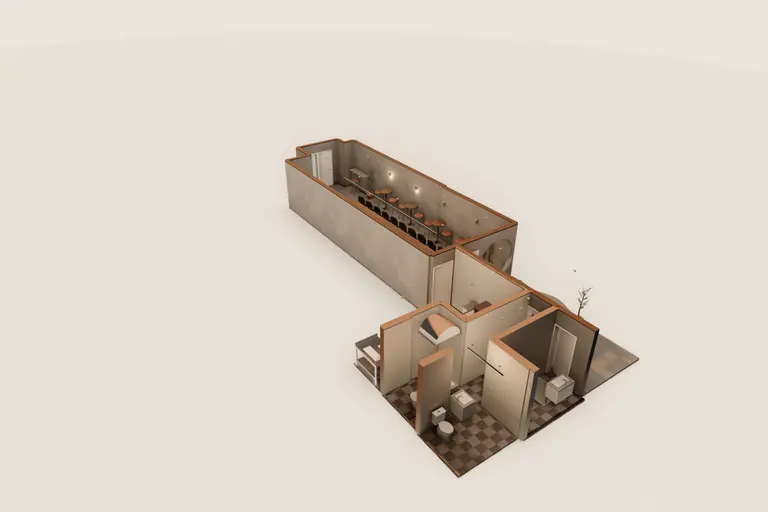
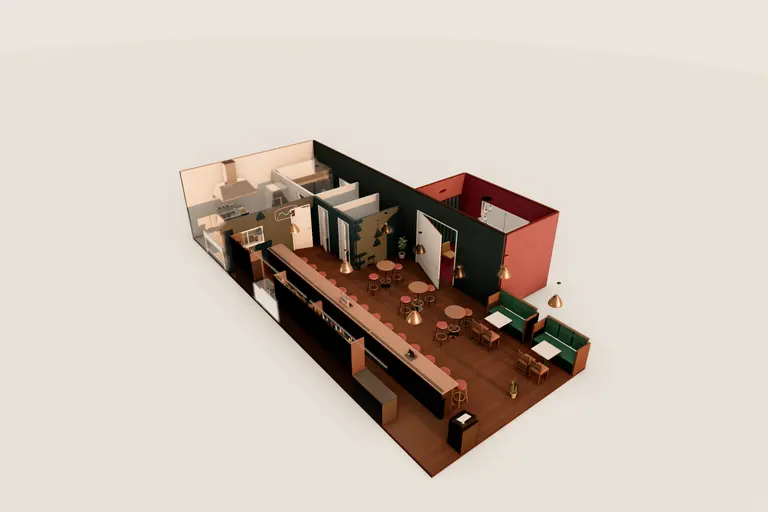
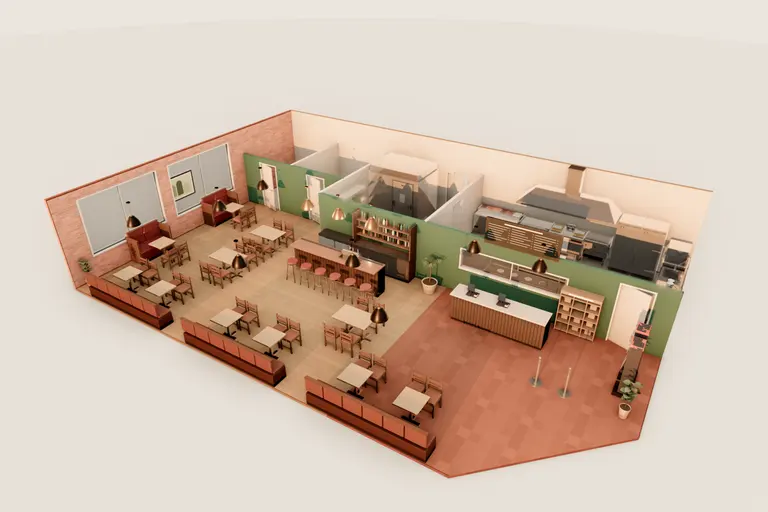
Three design habits follow. Draw the plan to scale before you submit it, so the dimensions on the diagram match the walls the contractor builds. Decide early where the bar, the service bar and any patio sit, because a change after approval can mean going back to the agency. And keep the license plan consistent with the one you give the health department; our guide to health department plan review lists what that drawing needs, and bar design dimensions covers heights, aisles and underbar layout. In the Wobistro studio you can lay out the room with a bar, tables and patio, and read dimensions off the plan; it does not produce an agency form, so treat it as the drawing you transcribe from.
What a bar adds to the equipment list
For an 80-seat bar, Wobistro’s simulator proposes a bar counter, 2 ice machines, 1 beer tap tower, 2 two-door reach-in fridges, 3 hand sinks and an undercounter dish machine, with a small hot line behind it. Those are planning allowances from the simulator, not a licensing requirement. The catalogue pages for the back-bar cooler, keg cooler, glass washer and ice machine show sizes and utilities. For the full budget, including license fees, see the cost to open a bar and the opening cost calculator.
Checklist before you file
- Name the agency in your state and read its current fee schedule and application instructions, not a summary.
- Pick the license type, and find out whether your county or municipality is at its population quota.
- Budget the state fee, any local fee, legal help and, in a quota area, the price of an existing license from sales you can verify.
- Register the business entity, then register the location with TTB before you sell.
- Prepare a dimensioned diagram of every floor, with bars, seating and any patio marked.
- Plan the community notice: posting, mailed notices or a municipal filing, as your agency requires.
- Make the lease conditional on the license, and set the opening date after the expected issue date.
The fastest way to avoid a redraw is to settle the layout first. The opening cost calculator takes the license fee as one input, and our guide to the cost to open a restaurant shows the other lines.
Work it out for your venue
- Open the Wobistro studio
Start from photos, a floor plan or an example venue and edit it in 3D, with the simulator built in.
- Restaurant codes by state
The food, building, plumbing and fire codes each state has adopted, with the official source for every line.
- Opening cost and break-even calculator
One-time opening budget with contingency and reserve, then the sales and covers that cover fixed costs.
Questions
Who issues a liquor license for a restaurant?
A state alcohol agency issues it, and some states add a local step. In this guide the agencies are California’s Department of Alcoholic Beverage Control, the Texas Alcoholic Beverage Commission, the New York State Liquor Authority and Florida’s state division, while New Jersey caps licenses by municipality. Federal law does not issue a retail license, only a registration.
What is the difference between a beer and wine license and a full liquor license?
A beer and wine license authorizes beer and wine only, while a general license also authorizes distilled spirits. California’s Type 41 is the beer and wine eating place license and Type 47 the general one. In New York the restaurant wine license and the on-premises liquor license are separate classes with different fees.
How much does a liquor license cost?
It depends on the state, the license type and the place. California’s 2026 application fee is $1,135 for a standard non-general license, New York’s two-year on-premises liquor fee is $1,792 to $4,352 plus a $200 filing fee, and Texas’s mixed beverage permit is $5,300 for the original two-year term on its 2021 chart. Check the current schedule.
Why are some liquor licenses limited in number?
Some states cap licenses by population. California limits general licenses to one for each 2,000 persons in the county, Florida allows one quota license for each 7,500 county residents, and New Jersey caps plenary retail consumption licenses at one for every 3,000 municipal residents. In a capped area you may have to buy an existing license.
How long does it take to get a liquor license?
It depends on the agency. California says most investigations take about 55 to 65 days and that a license cannot issue for at least 30 days, and Texas says a new license can take 30 to 35 days from a complete application. Do not plan an opening date, or order stock, until the license is issued.
Do I need a federal license to sell alcohol at a restaurant?
Not a federal retail license, but you must register. The Alcohol and Tobacco Tax and Trade Bureau says no one may sell distilled spirits, wine or beer without first registering the business on its dealer registration form, and that this applies to bars and restaurants. The state license is a separate requirement.
Sources
- U.S. Alcohol and Tobacco Tax and Trade Bureau, Retail beverage alcohol dealers, registration. Accessed November 22, 2026.
- Texas Alcoholic Beverage Commission, New TABC licenses and permits, timeline and certificates. Accessed November 22, 2026.
- New York State Liquor Authority, Instructions for on-premises retail application (rev. 07/30/25), 30-day notice; diagrams. Accessed November 22, 2026.
- California Department of Alcoholic Beverage Control, Licensing frequently asked questions, quota ratio, posting, investigation time, diagram. Accessed November 22, 2026.
- California Department of Alcoholic Beverage Control, License types, Type 41 and Type 47. Accessed November 22, 2026.
- New York State Liquor Authority, Restaurant license quick reference, license types and terms; filing requirements. Accessed November 22, 2026.
- Texas Alcoholic Beverage Commission, TABC licensing fees, two-year fees effective 9/1/21, Lower tier: retail. Accessed November 22, 2026.
- California Department of Alcoholic Beverage Control, Priority registration drawings: frequently asked questions, county population limit; purchase of an existing license. Accessed November 22, 2026.
- Florida Legislature, Florida Statutes 2025, section 561.20: Limitation upon number of licenses issued, subsection (1). Accessed November 22, 2026.
- New Jersey Division of Alcoholic Beverage Control, Advisory Notice 2024-05: Intermunicipal license transfer statute, paragraph 2, population cap. Accessed November 22, 2026.
- California Department of Alcoholic Beverage Control, Application fee schedules (effective January 1, 2026), General and non-general license tables. Accessed November 22, 2026.
- California Department of Alcoholic Beverage Control, Annual fee schedule (effective January 1, 2026), Types 41 and 47. Accessed November 22, 2026.
- New York State Liquor Authority, Schedule of retail license fees (rev. 6/12/26), Liquor, on-premises liquor (OP); required filing fee. Accessed November 22, 2026.
- Florida Legislature, Florida Statutes 2025, section 565.02: License fees, subsection (1), on-premises annual license tax by county population. Accessed November 22, 2026.
- California Department of Alcoholic Beverage Control, ABC-257 Licensed Premises Diagram (Rev. 11/2024), item 5 and declaration. Accessed November 22, 2026.
Figures marked as Wobistro estimates come from the simulator defaults described in our methodology. Found an error? Tell us and we will correct it under our editorial standards.
Related guides
More on opening a restaurantHow much does it cost to open a bar? A line-by-line budget method
Build a bar opening budget line by line: liquor license fees from official schedules, equipment families for an 80-seat bar, labour, a reserve and break-even.
Bar design dimensions: heights, depths and clearances for a commercial bar
Bar top height and depth, stools, footrail, underbar and back bar, the aisle behind the bar and accessible seating, with simulated bartenders and ice for a bar.
Health department plan review for restaurants: what to submit
What health departments ask for before you build or remodel a restaurant: plans, menu, equipment and finish schedules, review times and inspections.
How much does it cost to open a restaurant? Build the budget line by line
Build a US restaurant opening budget from the bottom up: equipment priced from a simulated list, build-out, pre-opening costs, a cash reserve and break-even.