How much does it cost to open a bar? A line-by-line budget method
Build a bar opening budget line by line: liquor license fees from official schedules, equipment families for an 80-seat bar, labour, a reserve and break-even.
Short answer
There is no honest single number for the cost to open a bar, because the space, the build-out, the liquor license and the menu set it. Build the budget line by line: the license fee from your state’s schedule, build-out from contractor bids, equipment from a list built for your drinks menu, pre-opening costs, a contingency and a cash reserve. Then run break-even with your own figures in the opening cost calculator.
Why this guide does not quote an average
Figures for the average cost of opening a bar circulate widely. Each comes from a survey or a vendor with its own sample, year and mix of venues, and a wine bar in a second-generation space is not a nightclub built from a shell. We did not find a recent survey whose sample and method we could check, so we quote no average. This guide does what a lender will ask you to do anyway: build the number from your own lines, and take every figure we can from an official source.
The U.S. Small Business Administration’s startup-cost guidance is the frame. It lists the common startup costs as space, equipment and supplies, communications, utilities, licenses and permits, insurance, a lawyer and an accountant, inventory, employee salaries, advertising and marketing, market research, printed marketing materials and a website [1]. For a bar, two of those are heavier than for most restaurants: licenses, and inventory, because the back bar is stocked before the first sale.
The budget lines for a bar
| Line | One-time or monthly | Where the number comes from |
|---|---|---|
| Liquor license and legal fees | One-time, then annual or biennial | The state agency’s fee schedule; in a quota area, the price of an existing license from verified sales |
| Lease deposit, first rent, architect and permits | One-time | Your lease, your design contract and the building department’s fee schedule |
| Build-out: bar, floors, restrooms, electrical, plumbing | One-time | Contractor bids on your drawings; the biggest unknown until the space is chosen |
| Bar and kitchen equipment | One-time | An equipment schedule from your drinks and food menu, priced line by line (see below) |
| Furniture, glassware, smallwares, point of sale | One-time | Your seat count and drinks menu |
| Opening inventory: spirits, beer, wine, mixers, garnish, kegs | One-time, then monthly | Your menu and your distributor’s price lists |
| Pre-opening payroll, training, launch marketing | One-time | Your opening schedule |
| Insurance, utilities, rent, salaried staff | Monthly | Quotes and your lease |
| Hourly labour | Monthly, varies with hours open | Crew per shift from the simulator, times local wages |
| Contingency and cash reserve | One-time | A percentage of the one-time costs; months of fixed costs |
The SBA suggests counting at least one year of monthly expenses when you work out how much capital you need and when, and says counting five years is ideal [1]. That does not mean holding a year of rent in the bank: it means the plan shows twelve months of costs against expected sales, so you can see how much cash covers the gap while the bar builds its trade.
Line 1: the liquor license
This is the one line for a bar that has an official price list, and it varies more than any other. The table shows state fees as the agencies publish them; our guide to how to get a liquor license explains the types, the quotas and the steps, and a license is a state decision, not a purchase.
| State | License | Fee from the official schedule |
|---|---|---|
| California | Type 41, on-sale beer and wine, eating place | $1,135 application fee plus a $565 annual fee collected with it (2026) [2] [3] |
| California | Type 47, on-sale general, eating place | $19,840 application fee for priority drawing winners, plus an annual fee of $985 to $1,545 by the city’s population (2026) [2] [3] |
| Texas | Mixed beverage permit | $5,300 original, two-year fee on the chart effective 9/1/21 [4] |
| New York | On-premises liquor, two-year term | $1,792 to $4,352 depending on location, plus a $200 non-refundable filing fee (rev. 6/12/26) [5] |
| Florida | On-premises vendor, annual license tax | $624 to $1,820 a year depending on county population (2025 statutes) [6] |
Where the number of licenses is capped, the fee is not the cost. California says the only way to a general license, other than a priority drawing, is to purchase an existing license of the same type within the same county [7]. We found no official source for those prices, so we do not quote one; ask a broker and an attorney, and make the lease conditional on the license.
Federal law adds a registration, not a fee we can quote: no one may sell spirits, wine or beer without first registering the business with the Alcohol and Tobacco Tax and Trade Bureau, for every location [8].
Line 2: equipment, from a simulated list
Equipment is where a simulator helps, because it starts from the drinks and food you will serve instead of a catalog. This is the list Wobistro’s simulator proposes for an 80-seat bar with a small hot line. Counts are the simulator’s planning allowances, with its sizing note where there is one. We list families and counts, not prices: equipment prices vary with brand, new or used, and finish, so get quotes for the largest items.
| Equipment | Count | Sizing note from the simulator |
|---|---|---|
| Bar counter | 1 | 3.5 m |
| Beer tap tower | 1 | — |
| Fryer | 1 | — |
| Refrigerated prep rail | 1 | — |
| Exhaust hood | 1 | 0.9 m, medium duty, about 750 cfm |
| Undercounter dish machine | 1 | 18 racks an hour at peak |
| Ice machine, 227 kg/day | 2 | 261 kg a day |
| Reach-in fridge, two door | 2 | 1.6 m³ for 3.5 days of stock |
| Reach-in freezer | 1 | a quarter of the chilled volume |
| Hand sink | 3 | one within reach of each line and one at dish |
| Three-compartment sink | 1 | manual pot and utensil washing |
| Point of sale | 2 | one terminal per 50 seats |
| Kitchen display | 1 | hot lines and expo |
| Heated pass | 1 | — |
| Prep table | 1 | one per 80 peak-hour covers |
Three groups matter most for a bar. Cold and ice: 2 ice machines, 2 two-door reach-in fridges and 1 freezer. See the catalog pages for the ice machine, back-bar cooler and keg cooler. Bar service: the bar counter, the beer tap tower and two point-of-sale stations. Washing: an undercounter dish machine and a three-compartment sink; if the bar serves many drinks, the glass washer is worth pricing. The simulator also adds a fryer, a refrigerated prep rail and a hood for the small kitchen behind the bar; if your bar sells only drinks and packaged snacks, remove those lines and the hood, which is a large cost of its own.
Three things are not in the list: the hood’s ductwork and fire suppression, if you keep a kitchen; furniture and glassware; and anything second-hand. Our equipment list by concept shows how the list changes for restaurants, cafés and bars, and bar design dimensions gives the heights and aisles that decide where these pieces go.
Line 3: labour, the biggest monthly line
The simulator sizes the crew from the busiest quarter-hour. For this bar it estimates about 5 people on the bar at the peak, an estimate to replace with your own staffing plan. For local pay, start from the Bureau of Labor Statistics: its 2025 median pay for bartenders is $16.51 an hour, or $34,340 a year [9]. That is a national median of pay, not the full cost of an employee: payroll taxes, workers’ compensation and any benefits come on top, and wages vary by city. Check your state’s tipped-wage rules before you budget bartenders at a cash wage below the minimum.
Space, and the line you decide first
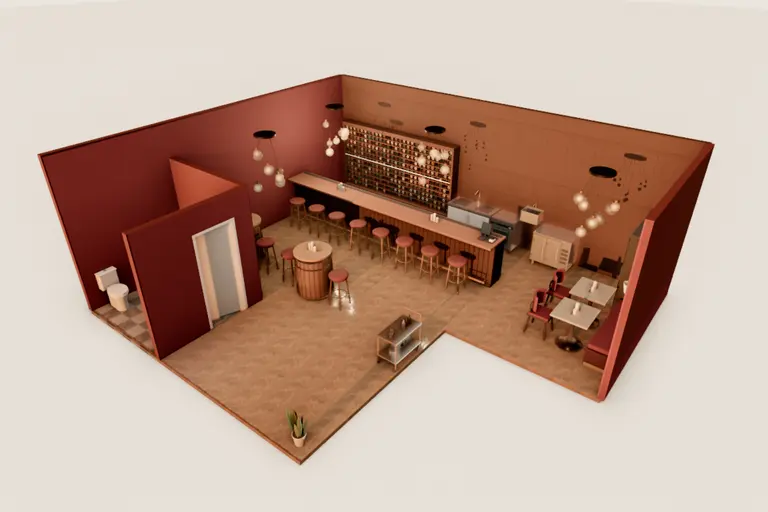
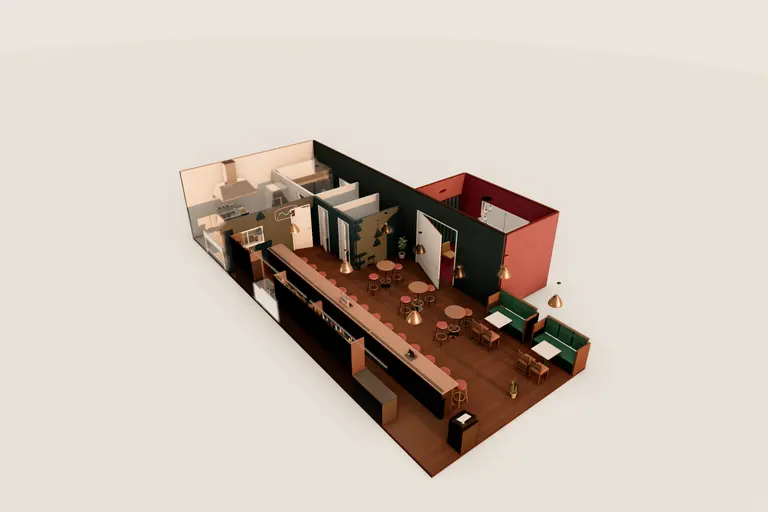
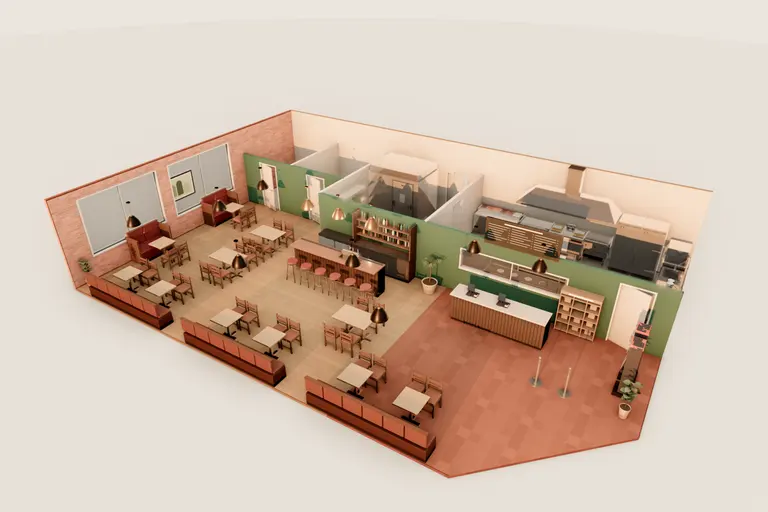
The simulator’s space estimate for an 80-seat bar is about 950 sq ft (88 m²) of dining and bar area and 320 sq ft (29 m²) of kitchen and back-of-house, with an occupant load of 64; the occupant load is sourced in the simulator’s code check and the areas are estimates. Rent per square foot is your market’s number, so multiply it yourself. Try the venue in the Wobistro studio before you sign: a plan that does not fit the space costs more to correct on site than on screen.
Contingency, reserve and break-even
The SBA defines the break-even point as the point at which total cost and total revenue are equal, and suggests adding a little extra, say 10 percent, to the break-even analysis to cover miscellaneous expenses you cannot predict [1]. In the opening cost and break-even calculator you enter the one-time costs, a contingency percentage, a reserve, monthly fixed costs, the average check and the variable-cost share. It returns the total budget, the monthly sales to break even and the covers per day that implies.
We do not print a total here, because every input that matters for a bar, the build-out, the license, the inventory and the rent, is yours. Fill the calculator with quotes and fees, run it once as it stands and once with fixed costs 10 percent higher, and compare the covers per day you need with what the room can seat; the planning numbers show simulated covers for seven concepts at four sizes, including bars. The same arithmetic is worked step by step in the cost to open a restaurant.
Opening budget checklist
- List one-time and monthly costs separately, using the SBA’s categories as a starting list.
- Look up your state agency’s current license fee schedule, and find out whether the county is at its quota.
- Build the equipment list from your drinks menu, and get quotes for the ice machines, coolers, dish machine and any hood.
- Get build-out bids on dimensioned drawings, with the bar and the plumbing marked.
- Cost opening inventory from your distributor’s price lists, not from a share of sales.
- Cost labour from a crew plan and local wages, with payroll taxes and your state’s tipped-wage rules.
- Show twelve months of costs against expected sales, and size the reserve from the gap.
- Run break-even with and without a 10 percent buffer, and compare it with the covers the room can serve.
The quickest way to a defensible equipment line is to lay out the venue: the studio proposes the equipment for your menu, and the plan shows whether the bar and its aisles fit the room.
Work it out for your venue
- Opening cost and break-even calculator
One-time opening budget with contingency and reserve, then the sales and covers that cover fixed costs.
- Planning numbers by concept
Simulated covers, crew, kitchen size, hood and ticket times for seven restaurant concepts at four sizes.
- Open the Wobistro studio
Start from photos, a floor plan or an example venue and edit it in 3D, with the simulator built in.
Questions
What is the average cost to open a bar?
We do not quote an average, because we could not verify a recent survey’s sample and method, and a bar in a leased shell has little in common with one built from scratch. This guide shows each budget line and where its number comes from, so you can build the total from your own quotes and the opening cost calculator.
How much is a liquor license for a bar?
It depends on the state and the license type. California’s 2026 application fee is $1,135 for a beer and wine license, New York’s two-year on-premises liquor fee is $1,792 to $4,352, and Texas’s mixed beverage permit was $5,300 for the original two-year term on its 2021 chart. Check your state’s current schedule.
What equipment does an 80-seat bar need?
For an 80-seat bar, Wobistro’s simulator proposes a bar counter, a beer tap tower, two ice machines, two reach-in fridges and a freezer, an undercounter dish machine, three hand sinks, a three-compartment sink and two point-of-sale stations, plus a small hot line with a fryer and hood. It is a planning list, not a quote.
How much cash reserve should a new bar have?
The SBA suggests counting at least one year of monthly expenses when you work out how much capital you need, and five years is ideal. How much of that you hold as cash depends on how fast sales are expected to cover costs, so size it from a month-by-month plan rather than a rule of thumb.
How do I calculate bar break-even?
Break-even is the point at which total cost and total revenue are equal, according to the SBA. The SBA also suggests adding about 10 percent to the analysis to cover expenses you cannot predict. The opening cost calculator turns your fixed costs, average check and variable costs into the sales and covers you need.
Sources
- U.S. Small Business Administration, Plan your business: calculate your startup costs, break-even point and business plan formats, startup costs, break-even. Accessed November 22, 2026.
- California Department of Alcoholic Beverage Control, Application fee schedules (effective January 1, 2026), General and non-general license tables. Accessed November 22, 2026.
- California Department of Alcoholic Beverage Control, Annual fee schedule (effective January 1, 2026), Types 41 and 47. Accessed November 22, 2026.
- Texas Alcoholic Beverage Commission, TABC licensing fees, two-year fees effective 9/1/21, Lower tier: retail. Accessed November 22, 2026.
- New York State Liquor Authority, Schedule of retail license fees (rev. 6/12/26), Liquor, on-premises liquor (OP); required filing fee. Accessed November 22, 2026.
- Florida Legislature, Florida Statutes 2025, section 565.02: License fees, subsection (1), on-premises annual license tax by county population. Accessed November 22, 2026.
- California Department of Alcoholic Beverage Control, Priority registration drawings: frequently asked questions, county population limit; purchase of an existing license. Accessed November 22, 2026.
- U.S. Alcohol and Tobacco Tax and Trade Bureau, Retail beverage alcohol dealers, registration. Accessed November 22, 2026.
- U.S. Bureau of Labor Statistics, Occupational Outlook Handbook: Bartenders, Quick Facts, 2025 median pay. Accessed November 22, 2026.
Figures marked as Wobistro estimates come from the simulator defaults described in our methodology. Found an error? Tell us and we will correct it under our editorial standards.
Related guides
More on opening a restaurantHow to get a liquor license for a restaurant: types, fees and steps
How a US restaurant gets a liquor license: the state agency, beer and wine versus full liquor, population quotas, state fee schedules and the premises diagram.
Bar design dimensions: heights, depths and clearances for a commercial bar
Bar top height and depth, stools, footrail, underbar and back bar, the aisle behind the bar and accessible seating, with simulated bartenders and ice for a bar.
How much does it cost to open a restaurant? Build the budget line by line
Build a US restaurant opening budget from the bottom up: equipment priced from a simulated list, build-out, pre-opening costs, a cash reserve and break-even.
Restaurant equipment list: what each concept needs
What a fast-casual restaurant, casual dining room, coffee shop, bar and pizzeria need at 80 seats, sized by Wobistro’s simulator, plus certification checks.