Food truck requirements: permits, plan review, tanks and fire safety
Short answer
A food truck needs a health permit for the unit, usually after the health department approves the plans for the build; a handwashing sink, a pressurized water system and a waste tank sized larger than the fresh water tank; a commissary or approved servicing base; and a fire inspection covering propane and cooking. Requirements are set by the county, state and city, so the numbers in this guide are named examples, not national rules.
Central production kitchen plan
On this page
The short list
Food truck rules come in four layers, from different agencies: the health department (the permit, the build and the commissary), the fire marshal (cooking and fuel), the city or the property owner (where you may park and sell) and the business license office. A truck can pass the first and still be shut by the second. The table lists what each layer asks for in the places this guide opened.
| Layer | What it usually decides | Example in this guide |
|---|---|---|
| Health department | The unit permit, plan review of the build, sinks, water and waste tanks, commissary | Maricopa County, King County, Los Angeles County |
| State | In some states the permit itself, or a code the counties follow | Florida; Texas from July 1, 2026 |
| Fire marshal | Hood and suppression, extinguishers, propane, inspection | Tucson Fire Department |
| City or property owner | Where you may vend, permit caps, restroom access | New York City; King County restroom letter |
The health permit
Every jurisdiction in this guide requires a permit for the unit itself, not only for the owner. Maricopa County, Arizona, says no person may operate a mobile food establishment without a valid permit, that a separate permit is needed for each establishment, and that permits cannot be transferred from person to person, event to event or vehicle to vehicle [1]. The county sorts units by what they do: Type I sells only commercially processed, individually packaged foods or non-time and temperature controlled beverages; Type II does limited handling and preparation; and Type III is an enclosed vehicle that prepares, cooks, holds and serves food [1]. A truck that cooks is a Type III.
Los Angeles County sorts vehicles by risk, with a high-risk mobile food truck defined as a fully enclosed unit where complex menu items are prepared and extensive food preparation occurs [2]. Operators there must tell Public Health their route and schedule, and update it when it changes significantly, under County Code section 8.04.403; failing to do so can lead to suspension or revocation of the permit [2].
Who issues the permit changes. Austin Public Health says that beginning July 1, 2026, mobile food vendors must hold a valid state Mobile Food Vending Permit from the Texas Department of State Health Services, while fire permits and inspections stay with Austin Fire or the Travis County Fire Marshal depending on location [3]. In Florida, the rule for mobile food dispensing vehicles is a state rule; it requires vehicles that are not self-sufficient to report to a commissary at least daily when in operation and the owner to notify the state of each commissary before using it [4].
Plan review for the truck build
The health department reads the drawings before the truck is built or converted, not after. Maricopa County says no Type II or Type III unit may be constructed, or have a major alteration made, unless detailed plans and specifications have been approved, and that all work must follow the approved plans [1]. King County says the same in one line: plan review approval is required before starting construction [5].
What goes in the package, according to King County: detailed drawings of the mobile food unit and its water system, photos of the unit, a menu and a food preparation flow chart, an operational questionnaire, a use of commissary agreement and a commissary permission letter with a drawing of the commissary, and a use of restroom agreement with a site or route form [5]. A restroom availability letter is required for each stop longer than one hour [5]. Initial review can take up to 8 to 10 weeks, and the pre-operational inspection should be requested at least one week before opening [6]. Opening without it can mean closure and fees, including 50 percent of the annual permit fee [6]. Our guide to health department plan review covers what reviewers look for in a fixed kitchen; the logic is the same on four wheels.
Buy the truck last. A used trailer or step van that cannot take the sinks or tanks your department requires is expensive to fix. Ask the plan reviewer for the checklist first, and build or buy to it.
Sinks, water and waste tanks
The Food Code model sets the principle: the sewage holding tank on a mobile food establishment must be sized 15 percent larger in capacity than the water supply tank and sloped to a drain that is 1 inch (25 mm) in inner diameter or greater, with a shut-off valve [7]. Wastes must be removed at an approved waste servicing area or by a sewage transport vehicle [7]. The Food Code’s own guide says the plan review decision on support services should be based on the menu, the type of operation and the equipment on board [7].
Counties add specifics. Maricopa County’s rules for an enclosed Type III vehicle, the type a cooking truck falls under, are among the most detailed published:
- A pressurized potable water system supplying hot and cold water with a minimum capacity of 30 gallons (114 L), permanently installed for utensil washing and sanitizing and handwashing [1].
- A permanently installed hand washing sink measuring 9 by 9 by 5 inches [1].
- A three-compartment sink for washing and sanitizing, with a flow of at least one-half gallon per minute, water of at least 100°F (38°C) from a mixing faucet, each compartment holding 6 gallons, and two integral metal drain boards [1].
- A produce prep sink for washing only, allowed if an additional 20 gallons of potable water is available [1].
- A sewage holding tank 15 percent larger than the water supply tank, so a 30 gallon system needs at least 34.5 gallons of waste capacity [1].
- A water tank inlet no larger than three-fourths inch in inner diameter, with a hose connection that cannot be used for any other service [1].
- No connections to water or wastewater systems except during servicing at a commissary or as the department approves [1].
Those are Maricopa County numbers, not national ones. King County’s published plan-review page does not state tank sizes, and the Florida rule I opened does not either [5] [4]. Ask your department for its mobile unit guide before you size a tank.
Two practical points follow from the 15 percent rule. A bigger fresh water tank forces a bigger waste tank, and both add weight and floor area, so choose the water capacity from your menu and warewashing needs rather than from the largest tank that fits. And a unit with a larger menu needs more of everything: Maricopa County’s Type II units, which do only limited handling and preparation, need a self-contained handwashing sink with a minimum 5 gallon potable water tank and a 15 percent greater waste tank [1].
The commissary
Most departments want a base: a permitted kitchen where the truck stores food, cleans, fills water and dumps waste. Maricopa County says mobile establishments must operate from an approved commissary and report there at least daily [1]; New York City says units must return at least once daily and be stored there when not in use [8]. The commissary agreement is part of the application in both King County and Maricopa County [6] [1]. Our guide to the commissary kitchen covers what it must provide, the exemptions and the shared versus private choice.
Fire safety for propane and cooking
Fire rules are written by the fire marshal and usually derive from NFPA standards that your jurisdiction has adopted. The clearest openable example is the Tucson Fire Department’s handout for mobile food vehicles, which says:
- A Type I hood goes over commercial cooking appliances that produce grease vapors, and the hood and its extinguishing system must be tested and inspected every six months by a contractor [9].
- Every vendor needs a fire extinguisher of at least 2-A:10-BC in the truck, plus a Class K portable extinguisher of at least 6 L for wet chemical extinguishing systems and at any outdoor deep fryer [9].
- No more than two LP-gas containers with a total aggregate water capacity of 25 gallons on one vehicle; LP hose marked for a 350 psig working pressure; no copper pipe; gas shut off while the vehicle is in motion, unattended or in overnight storage; and an emergency shut-off on the exterior [9].
- A working carbon monoxide detector and an LPG leak indicator, both referenced to NFPA 1192 [9].
- Open flame or grease-vapor equipment may not operate under tents or canopies [9].
The handout is dated June 2023 and reflects Tucson’s adopted rules; another city may set different limits. Treat it as a checklist of what to ask, and read restaurant fire suppression systems and commercial kitchen hood requirements for how hood and suppression rules work in a fixed kitchen.
Where you can park and sell
A health permit does not give you a place to sell. New York City is a good example of how tight it can be: the number of street food permits is capped by law, vending on public sidewalks and streets is restricted in certain areas, and restricted area permits allow vending only on private property or on city Parks property with the owner’s agreement [8]. Maricopa County sets conditions at the site: a toilet within 200 feet if a unit stays more than an hour, no temporary toilet within 25 feet of a unit, and no placement within 100 feet of an animal petting, riding or holding area unless dust and runoff are controlled [1]. King County’s restroom letter for any stop longer than an hour works the same way [5].
I could not open the street vending ordinances of Los Angeles or Seattle on the access date, so they are not described here. Whatever the city, get written permission from the property owner, the event organizer and the city for each location, and carry it.
Where Wobistro helps, and where it does not
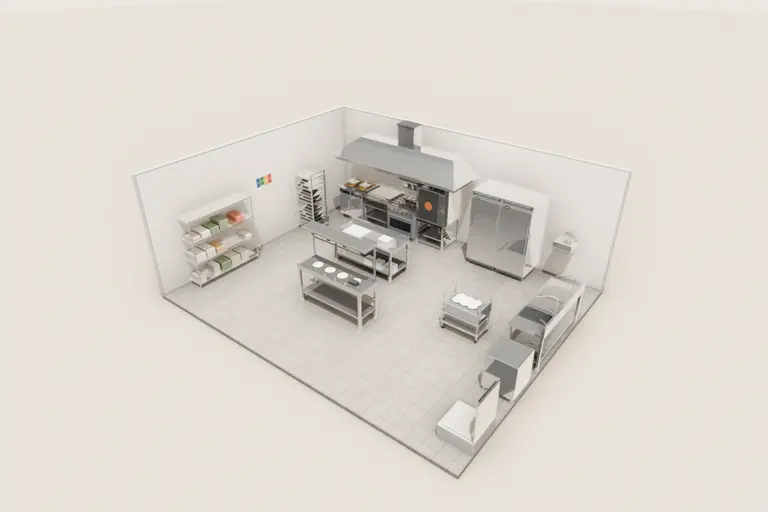
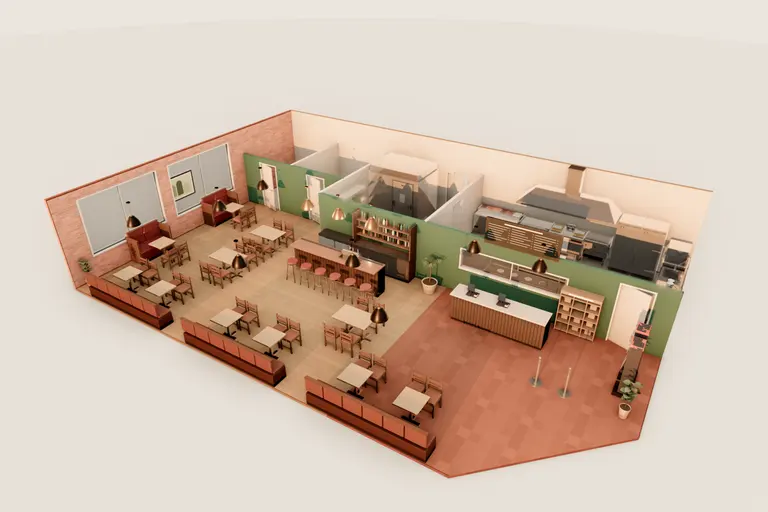
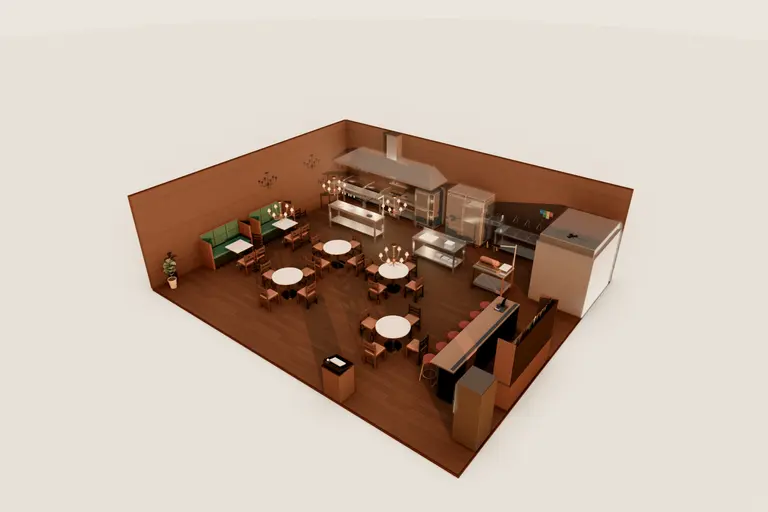
Wobistro does not design the truck. Its planner does not model the inside of a vehicle, tank sizes or LP-gas systems, and its simulator is not a substitute for a plan reviewer. What it can plan is what sits around the truck. The commissary or prep kitchen behind it can be laid out from the central production kitchen plan, or the dark kitchen plan if you also cook for delivery. The example venue “food truck plaza seating” in the studio shows how a truck, a queue and outdoor tables fit on a plaza, which helps when you pitch a landlord or an event for a regular spot. For which food, building and fire codes your state has adopted, see the codes by state reference.
Food truck checklist
- Ask the health department that will permit the unit for its mobile unit guide and plan review checklist before buying a truck.
- Confirm which type of permit your menu needs and whether the permit is county or state.
- Draw the water system, handwashing sink, warewashing sink and waste tank on the plans, with capacities your department accepts.
- Size the waste tank at least 15 percent above the fresh water tank, or to the larger figure your department sets.
- Sign a commissary agreement and a restroom agreement, and attach the commissary drawing.
- Book the fire inspection: hood and suppression, extinguishers, propane containers, hoses, shut-offs and detectors.
- File your route or schedule where required, and keep your visit logs.
- Get written permission for every place you plan to vend.
Work it out for your venue
- Central production kitchen plan
Zones, areas and equipment for a production or commissary kitchen, computed by the kitchen planner.
- Restaurant codes by state
The food, building, plumbing and fire codes each state has adopted, with the official source for every line.
- Open the Wobistro studio
Start from photos, a floor plan or an example venue and edit it in 3D, with the simulator built in.
Questions
What permits does a food truck need?
A health permit for the unit, issued by the county or state where it is based, and often approval of the plans before the truck is built. Maricopa County requires a separate permit for each mobile food establishment, and Texas moved mobile vending permits to the state on July 1, 2026. Fire inspection and city vending rules are separate.
How big does a food truck waste tank need to be?
Larger than the fresh water tank. The FDA Food Code model sizes the sewage holding tank 15 percent larger than the water supply tank, and Maricopa County repeats that rule. For a 30 gallon fresh water system, that works out to at least 34.5 gallons of waste capacity.
Does a food truck need a commissary?
Usually, yes. Maricopa County requires mobile units to report to an approved commissary at least daily, New York City requires at least one visit daily, and Florida requires it for vehicles that are not self-sufficient. Washington State lets a unit that meets set conditions apply for an exemption.
How many propane tanks can a food truck carry?
It depends on the fire department. Tucson’s handout allows a maximum of two LP-gas containers with a total aggregate water capacity of 25 gallons on one mobile food vehicle, and requires the gas to be shut off while the vehicle is moving, unattended or in overnight storage. Other cities set their own limits.
Can I park a food truck anywhere?
No. Health permits do not grant a place to vend. New York City restricts vending on public sidewalks and streets in certain areas, and Maricopa County requires a toilet within 200 feet if a truck stays at one site for more than an hour. Check the city, the property owner and the event organizer.
Sources
- Maricopa County Environmental Services Department, Environmental Health Code, Chapter VIII, Section III: Mobile Food Establishments (rev. 08/19/2026), Regulations 1, 3, 4, 5, 8 and 9. Accessed November 22, 2026.
- Los Angeles County Department of Public Health, Food trucks and carts, vehicle categories and route sheet. Accessed November 22, 2026.
- Austin Public Health, Mobile food vendors, state permit transition and fire contacts. Accessed November 22, 2026.
- Florida Administrative Code (as republished by Cornell Legal Information Institute), Rule 61C-4.0161: Mobile Food Dispensing Vehicles, Temporary Commercial Kitchens and Theme Park Food Carts, paragraph (2)(c)–(e) and (2)(h). Accessed November 22, 2026.
- Public Health – Seattle & King County, Mobile food plan review, documents to submit. Accessed November 22, 2026.
- Public Health – Seattle & King County, Mobile food business permit and mobile food plan review, permit steps, plan review and commissary paperwork. Accessed November 22, 2026.
- U.S. Food and Drug Administration, Food Code 2022 (January 18, 2023 version), §5-401.11; §5-402.14; Annex 7 Chart 4-D guidance. Accessed November 22, 2026.
- NYC Department of Health and Mental Hygiene, Mobile food vendors, permits, commissary and vending locations. Accessed November 22, 2026.
- Tucson Fire Department, Mobile Food Trucks, Trailers, and Carts Information (rev. 06.22.23), general requirements; propane and other fuel requirements. Accessed November 22, 2026.
Figures marked as Wobistro estimates come from the simulator defaults described in our methodology. Found an error? Tell us and we will correct it under our editorial standards.
Related guides
More on bars, cafés and delivery kitchensCommissary kitchen: what it is, what it needs and who must use one
What a commissary kitchen is under the FDA Food Code, why food trucks and caterers need one, what it must provide, and how shared and private ones differ.
Health department plan review for restaurants: what to submit
What health departments ask for before you build or remodel a restaurant: plans, menu, equipment and finish schedules, review times and inspections.
Restaurant fire suppression system requirements and Class K extinguishers
When a kitchen hood needs a fire suppression system, what it shuts off, where the pull station and Class K extinguisher go, and how often both are serviced.
Commercial kitchen hood requirements: Type I, Type II and airflow
When a restaurant needs a Type I or Type II hood, how far it must overhang, clearances, and how exhaust airflow is set, with a worked sizing example.